Custom AI Silicon at the Hyperscalers: TPU, Trainium, Maia, MTIA and the OpenAI–Broadcom Chip
Tech industryAI chipsAmazonAnthropicBroadcomGoogleMetaMicrosoftOpenAI
Google, AWS, Microsoft and Meta began designing AI accelerators to run their own workloads rather than rely solely on merchant GPUs; the programs have since expanded into large external and frontier-lab deployments. AWS has put nearly 500,000 Trainium2 chips into Anthropic’s Project Rainier, Google has made Ironwood generally available and is selling TPU capacity to Anthropic and Meta, while Meta, Microsoft and OpenAI are moving their next designs toward much larger deployments. Anthropic has committed to both up to 5 GW of AWS Trainium capacity and 3.5 GW of future Google TPU capacity, while OpenAI and Meta have each committed to Broadcom-backed custom-chip roadmaps. The central question is whether these chips can move from vendor performance claims, limited rollouts and engineering samples to reliable multi-gigawatt production on the announced schedules, amid foundry, substrate and packaging constraints.
Key moments
- Nov 15, 2023Microsoft unveils Maia 100, its first AI accelerator, at Ignite
- Nov 28, 2023AWS announces Trainium2: 4x faster training, clusters of 100,000 chips, Anthropic among first users
- Dec 6, 2023Google's TPU v5p arrives with Gemini, which was trained and served on TPUs
- Apr 9, 2025Ironwood: the seventh TPU, built for inference, scales to 9,216 chips and 42.5 exaflops
- Oct 13, 2025OpenAI and Broadcom: 10 gigawatts of OpenAI-designed accelerators from late 2026 to 2029
- Oct 23, 2025Anthropic commits to up to one million Google TPUs, more than a gigawatt in 2026
- Oct 29, 2025Project Rainier is live: nearly 500,000 Trainium2 chips, Claude on more than a million by year-end
- Mar 11, 2026Meta lays out four MTIA generations in two years: 300, 400, 450 and 500, on a six-month cadence
- Apr 20, 2026Amazon puts up to $25 billion more into Anthropic; Anthropic commits $100 billion to AWS and up to 5 GW of Trainium
- Apr 22, 2026Cloud Next: Ironwood for everyone, and an eighth generation split into TPU 8t for training and TPU 8i for inference
- Sep 2, 2026Broadcom Q3: AI revenue $16.7 billion, six XPU customers, Anthropic to be the largest in 2027 with 5 GW of TPU 8i
- Oct 12, 2026Microsoft targets multi-gigawatt Azure Maia deployments from 2027
Timeline
Earlier years show only their entries' dates and titles. Click a year heading to show the details.
202630 entries
- Launch
Meta introduces Tahan Ethernet scale-up switch for MTIA 300
Meta introduced Tahan, an Ethernet-based scale-up switch. Meta said Tahan was purpose-built for its MTIA 300 training accelerators.
- Engineering at Meta · Oct 12, 2026 ·
We’re introducing Tahan, Meta’s Ethernet-based scale-up switch — purpose-built for our MTIA 300 training accelerators.
Editor's note: Meta’s cited Engineering post states that it is introducing Tahan, calls it an Ethernet-based scale-up switch, and says it was purpose-built for MTIA 300 training accelerators. The cited URL is dated 2026-10-12.
- Engineering at Meta · Oct 12, 2026 ·
- AnnouncementKey moment
Microsoft targets multi-gigawatt Azure Maia deployments from 2027
Microsoft said it would scale the Azure Maia family to multi-gigawatt deployments starting in 2027. Microsoft said Maia would become its primary inference system for its products and services.
- Microsoft · Oct 12, 2026 ·
We will scale our Azure Maia family to multi-gigawatt deployments starting in 2027, making Maia the primary inference system for Microsoft products and services.
- CNBC · Oct 12, 2026 ·
Microsoft is targeting multi-gigawatt deployments of chips in the Maia family, according to a blog post from Executive Vice President Scott Guthrie.
Editor's note: Microsoft’s blog states both that Azure Maia will scale to multi-gigawatt deployments starting in 2027 and that it will be the primary inference system for Microsoft products and services. CNBC also reports the multi-gigawatt target and identifies the announcement as occurring on Monday, October 12, 2026.
- Microsoft · Oct 12, 2026 ·
- Update
Google claims TPU 8i has 80% better price-performance
Google Cloud said its TPU 8i system delivers 80% better price-performance than the prior generation. Google Cloud linked the claim to agent tasks.
- Google Cloud · Oct 9, 2026 ·
For example, our latest TPU 8i system delivers 80% better price-performance than the prior generation, making complex, high-value agent tasks both fast and highly affordable.
Editor's note: Google Cloud’s post is dated October 9, 2026 and states that its latest TPU 8i system delivers 80% better price-performance than the prior generation. It says this makes complex, high-value agent tasks fast and highly affordable.
- Google Cloud · Oct 9, 2026 ·
- Shipment
Marvell says it ships custom silicon to four U.S. hyperscalers
Marvell Technology, Inc. said it was shipping custom silicon to all four U.S. hyperscalers. It said fiscal-2026 custom silicon was an approximately $1.5 billion business and described XPU attach across networking, memory, storage, infrastructure management, and inference acceleration.
- StockAnalysis, transcript of Marvell Investor Day · Oct 6, 2026 ·
“We have already announced multiple large strategic agreements around these opportunities, and today we are shipping custom silicon to all four U.S. hyperscalers.”
- Quartr · Oct 6, 2026 ·
“FY26 custom silicon was a ~$1.5B business, shipping to all four U.S. hyperscalers; XPU attach spans networking, memory, storage, infrastructure management and inference acceleration.”
Editor's note: Both cited pages describe the October 6, 2026 Investor Day and support all elements of the summary, including shipments to all four U.S. hyperscalers, approximately $1.5 billion in FY26 custom-silicon revenue, and the listed XPU-attach areas.
- StockAnalysis, transcript of Marvell Investor Day · Oct 6, 2026 ·
- Financial
Marvell raises fiscal-2029 custom-revenue target above $12 billion
Marvell Technology, Inc. raised its fiscal-2029 custom-revenue target to more than $12 billion, above its prior target of more than $10 billion. Marvell said the target would more than triple fiscal-2028 custom revenue and cited broader XPU-attach wins.
- StockAnalysis, transcript of Marvell Investor Day · Oct 6, 2026 ·
“We now expect custom revenue in FY 2029 to more than triple from FY 2028, reaching more than $12 billion and putting us well above our prior $10 billion target.”
- Quartr · Oct 6, 2026 ·
“Custom revenue expected to exceed $12B in FY29, more than tripling from FY28 and exceeding the prior >$10B target; broader XPU attach wins drove the increase.”
Editor's note: Both cited pages state that Marvell raised its FY2029 custom-revenue outlook to more than $12 billion, above the prior more-than-$10-billion target. They also support that the target implies more than tripling from FY2028 and that expanding/broader XPU-attach opportunities or wins drove the increase.
- StockAnalysis, transcript of Marvell Investor Day · Oct 6, 2026 ·
- Response
OpenAI says Jalapeño capacity will serve its own compute demand
OpenAI hardware chief Richard Ho said the company would have its hands full providing compute for OpenAI for a long time. The statement concerned Jalapeño.
- Tom's Hardware · Sep 29, 2026 ·
I think that we're going to have our hands full just providing compute for OpenAI for a good long time.
Editor's note: The article says Richard Ho stated that OpenAI would have its hands full meeting its own growing compute demand for a good long time, in the context of Jalapeño. The readable page text does not provide an event or publication date to support 2026-09-29.
- Tom's Hardware · Sep 29, 2026 ·
- Report
Banks arrange reported $22 billion Crux AI loan for Google TPUs
Reuters and Bloomberg reported that banks were arranging a $22 billion loan for Crux AI. Reuters reported that the debt would be used to purchase Google TPUs, while Bloomberg reported it could later be replaced with longer-term institutional financing.
- Reuters via MarketScreener · Sep 16, 2026 ·
The debt will be used to purchase Google TPUs.
- Bloomberg via Yahoo Finance · Sep 16, 2026 ·
The debt could be replaced later with longer-term financing from institutional investors in the investment-grade bond market, the people said.
Editor's note: The page reports that 10 banks were providing a $22 billion chip loan for Blackstone and Alphabet's Crux AI venture. It states that the debt would purchase Google TPUs and, citing Bloomberg News, says it could later be replaced by long-term institutional financing.
- Reuters via MarketScreener · Sep 16, 2026 ·
- Report
Meta targets MTIA 450 deployment in the first half of 2027
Meta engineering vice president Song Ijun said MTIA 450, code-named Arke, was planned for introduction to data centers in the first half of 2027. The statement was reported as a Bloomberg interview conducted on September 15.
- ChosunBiz, reporting a Bloomberg interview · Sep 16, 2026 ·
Song Ijun, vice president of engineering overseeing Meta's in-house semiconductor project, said in a Bloomberg interview on the 15th (local time) that the third-generation AI chip "MTIA 450" (code name Arke) is planned for introduction to data centers in the first half of next year.
Editor's note: The article states that Song Ijun said in a Bloomberg interview on September 15 (local time) that MTIA 450 (Arke) is planned for data-center introduction in the first half of the following year. As the article was published on 2026-09-16, this corresponds to the first half of 2027.
- ChosunBiz, reporting a Bloomberg interview · Sep 16, 2026 ·
- Response
Sarah Friar says OpenAI needs multiple chip providers
OpenAI CFO Sarah Friar said the company needs multiple providers to manage supply-chain risk. She cited the possibility that a supplier, including TSMC, might not provide needed capacity.
- CNBC · Sep 15, 2026 ·
You never know when someone's supply chain is going to get gummed up, so you need to have multiple providers.
Editor's note: The transcript says Friar described supply-chain diversification as CFO risk mitigation and stated that multiple providers are needed because a supply chain can get "gummed up." She also specifically raised the risk that TSMC might not be able to provide all needed wafers; the page is dated September 15, 2026.
- CNBC · Sep 15, 2026 ·
- Response
OpenAI says it did not announce Samsung chip manufacturing plans
OpenAI said it had not announced plans to manufacture chips through Samsung Electronics. It said it had nothing new to announce regarding reports about next-generation chips.
- Data Center Dynamics · Sep 10, 2026 ·
We did not announce plans to manufacture chips through Samsung.
- Reuters via MarketScreener · Sep 10, 2026 ·
We have nothing new to announce on this front.
- Reuters via MarketScreener · Sep 9, 2026 ·
We have nothing new to announce on this front,
Editor's note: Date corrected from 2026-09-10 to 2026-09-09. The page states that an OpenAI spokesperson said it had nothing new to announce and did not announce plans to manufacture chips through Samsung. The article is dated September 09, 2026, not September 10, 2026.
- Data Center Dynamics · Sep 10, 2026 ·
- Report
Broadcom says it is building substrate capacity in Singapore
Broadcom said substrate issues were leading it to build substrate capacity at scale in its Singapore factory. It said it was doing so jointly with one of its partners.
- The Motley Fool transcript of Broadcom's earnings call · Sep 9, 2026 ·
And then even deeper than that, we talk about substrates, which is specific issues, which is leading us to build our own substrate capacity at scale in our factory in Singapore, jointly with one of our partners.
Editor's note: The transcript contains the quoted statement, attributing it to Hock Tan. The call is dated Wednesday, September 2, 2026, matching the node date.
- The Motley Fool transcript of Broadcom's earnings call · Sep 9, 2026 ·
- Report
Broadcom says post-Jalapeño XPU is nearing tape-out
Broadcom said it and OpenAI were developing a next-generation XPU beyond Jalapeño. Broadcom said the chip was approaching tape-out.
- The Motley Fool transcript of Broadcom's earnings call · Sep 9, 2026 ·
Together with OpenAI, we are deep in development of the next-generation XPU beyond Jalapeno, which is approaching tape-out.
Editor's note: The transcript states that Broadcom and OpenAI were developing a next-generation XPU beyond Jalapeno and says it was approaching tape-out. The call date shown on the page is September 2, 2026.
- The Motley Fool transcript of Broadcom's earnings call · Sep 9, 2026 ·
- Shipment
Broadcom begins production shipments of Google TPU 8i
Broadcom said it began production shipments of the next-generation TPU 8i for Google. The statement was made during Broadcom's fiscal third-quarter earnings call.
- The Motley Fool transcript of Broadcom's earnings call · Sep 9, 2026 ·
At the same time, we began production shipments of the next-generation TPU version 8i for Google.
Editor's note: The transcript states that Broadcom "began production shipments of the next-generation TPU version 8i for Google." The call is dated Wednesday, September 2, 2026, so the stated event date is supported.
- The Motley Fool transcript of Broadcom's earnings call · Sep 9, 2026 ·
- FinancialKey moment
Broadcom Q3: AI revenue $16.7 billion, six XPU customers, Anthropic to be the largest in 2027 with 5 GW of TPU 8i
Broadcom's AI semiconductor revenue more than tripled to $16.7 billion with custom accelerators 73 percent of it, and Hock Tan laid out the customer roadmap: multi-tens of billions of dollars of TPUs a year for Google, 1 GW of Ironwood for Anthropic in 2026 then 5 GW of TPU 8i in 2027 and 10 GW more in 2028, 1.3 GW of Jalapeño for OpenAI in 2027 with a second generation near tape-out and a third in development, and MTIA production shipments for Meta. Guidance: $21.7 billion of AI revenue in Q4, $58 billion for fiscal 2026 and about $115 billion in fiscal 2027.
- Broadcom Inc. Investor Relations · Sep 2, 2026 ·
Q3 AI semiconductor revenue of $16.7 billion grew 221% year-over-year, and 54% quarter-over-quarter,
- Broadcom Q3 FY2026 earnings call (Motley Fool transcript) · Sep 2, 2026 ·
Our 6 XPU customers are accelerating the adoption of custom accelerators and AI semiconductor revenue more than tripled year-over-year to $16.7 billion.
- Broadcom Q3 FY2026 earnings call (Motley Fool transcript) · Sep 2, 2026 ·
We expect Anthropic to deploy another 5 gigawatts of TPU version 8i in 2027. And in 2028, we have clear line of sight to deliver another -- an incremental 10 gigawatts, even as we expect Google to grow for us. Anthropic is on track to become our largest XPU customer in 2027 and sustain that in 2028.
- CNBC · Sep 2, 2026 ·
CEO Hock Tan said on a conference call that Broadcom expects to speed up shipments of Google Ironwood tensor processing units to Anthropic and TPU 8i chips to Google. He said Broadcom will deliver tens of billions of dollars of processors to Google each year for the next several years.
Editor's note: Official source added: https://investors.broadcom.com/news-releases/news-release-details/broadcom-inc-announces-third-quarter-fiscal-year-2026-financial
- Broadcom Inc. Investor Relations · Sep 2, 2026 ·
- Shipment
Meta receives 12 new chip samples from TSMC
Bloomberg reported that 12 units of Meta's new model arrived from TSMC on September 1. The report said their performance was within 2% to 3% of Meta's simulations.
- Bloomberg via Yahoo en Español · Sep 15, 2026 ·
Doce unidades del nuevo modelo llegaron a Meta desde TSMC el 1 de septiembre y su rendimiento se encuentra entre 2% y 3% de lo que habían indicado las simulaciones de la compañía.
Editor's note: La página afirma que doce unidades del nuevo modelo llegaron a Meta desde TSMC el 1 de septiembre y que su rendimiento estuvo entre 2% y 3% de las simulaciones de la compañía. La cita aparece textualmente en la página.
- Bloomberg via Yahoo en Español · Sep 15, 2026 ·
- Launch
Google and Blackstone launch TPU cloud venture Crux AI
Data Center Dynamics reported that the Google and Blackstone neocloud offering TPU services launched as Crux AI. Bloomberg reported that Blackstone provided $5 billion and that Crux AI aims to rent Google AI processors to customers in 2027.
- Data Center Dynamics · Sep 10, 2026 ·
The neocloud set up by Google and Blackstone to offer TPU services has officially launched as Crux AI.
- Bloomberg · Sep 9, 2026 ·
Crux AI — known internally as “Project Braid” — was launched with $5 billion from Blackstone and aims to rent Google AI processors to customers in 2027.
Editor's note: Both cited pages support the launch of Crux AI as a Google-Blackstone TPU neocloud, Blackstone's $5 billion backing, and the plan to rent Google AI processors to customers in 2027. Source 1 is dated September 10, 2026, supporting the node's September 2026 date.
- Data Center Dynamics · Sep 10, 2026 ·
- Report
OpenAI publishes Jalapeño performance claims
OpenAI said Jalapeño delivered 1.5 to 1.9 times more AI work per watt at peak throughput and 1.7 to 3.6 times lower end-to-end latency than comparison systems. SemiAnalysis said it verified InferenceX runs in OpenAI's lab but did not run the full InferenceX benchmark suite or see AgentX results.
- OpenAI · Aug 25, 2026 ·
Across all three, Jalapeño delivered 1.5 to 1.9 times more AI work per watt at peak throughput and 1.7 to 3.6 times lower end-to-end latency than the comparison systems.
- SemiAnalysis · Aug 25, 2026 ·
We verified the InferenceX runs in person in the lab, but we did not run the full suite of InferenceX benchmarks nor have we seen AgentX results.
Editor's note: Both cited pages support the performance figures and SemiAnalysis's stated verification caveat. Both are dated 2026-08-25.
- OpenAI · Aug 25, 2026 ·
- Announcement
OpenAI discloses a 128-chip Jalapeño deployment configuration
OpenAI disclosed a 128-chip Jalapeño deployment configuration. Data Center Dynamics reported that the deployment provides 1.7 exaflops of 4-bit compute and 27.5 TB of HBM4.
- Data Center Dynamics · Aug 25, 2026 ·
The 128 deployment is capable of 1.7 exaflops of 4-bit compute, with 27.5TB of HBM4.
Editor's note: The page states that OpenAI will deploy Jalapeño in 128-chip racks and gives the stated 1.7 exaflops of 4-bit compute and 27.5TB of HBM4. It is dated August 25, 2026.
- Data Center Dynamics · Aug 25, 2026 ·
- Report
Hot Chips 2026: Meta and Microsoft open up MTIA 400 and Maia 200; AI accelerators become the biggest track
Meta presented the MTIA 400 from its March roadmap and Microsoft gave its deepest account of Maia 200's architecture: 140 billion transistors, six HBM3E stacks and a 750 W envelope, a deliberately less aggressive design than its rivals'. ServeTheHome noted that AI accelerators had overtaken CPUs as the largest track at the conference, a measure of how much engineering the hyperscalers now put into their own silicon.
- ServeTheHome · Aug 24, 2026 ·
Though by no means a small chip at 140 billion transistors, Microsoft has paired the accelerator with just 6 stacks of HBM3e memory, and the total chip TDP is just 750 Watts.
- ServeTheHome · Aug 24, 2026 ·
Once a part of the GPU track, AI accelerators have become the largest track at the show – overtaking CPUs – underscoring just how much in the way of engineering resources have been invested into the chips in order power several projects.
- ServeTheHome · Aug 24, 2026 ·
- Report
Microsoft plans a Maia 300 reveal in September and 300,000-plus chips from TSMC for 2027
The Information reported that Microsoft was targeting a public unveiling of Maia 300 as soon as September and negotiating TSMC capacity for more than 300,000 units in 2027, an order dwarfing the tens of thousands of Maia 200 chips built so far, with a longer-term aim of more than a million. Maia 200 had been delayed after early tests missed targets and was running in only a few data centers; Nadella had told investors on July 29 it delivered 30 percent better performance per dollar.
- Investing.com (via Yahoo Finance) · Aug 10, 2026 ·
Microsoft is targeting a public unveiling of its next-generation Maia 300 AI accelerator as soon as September. It has also entered talks to secure manufacturing capacity for more than 300,000 units from TSMC, with delivery planned for 2027, The Information reported Monday, citing two people with direct knowledge of the plans.
- Investing.com (via Yahoo Finance) · Aug 10, 2026 ·
The Maia 200 was delayed after early tests fell short of internal goals and has since been deployed in only a small number of data centers. CEO Satya Nadella told investors on Microsoft's Q4 FY2026 earnings call on July 29 that the chip delivers 30% better performance per dollar compared to existing hardware and is scaling to support OpenAI and MAI models.
- Microsoft · Oct 12, 2026 ·
Maia 300 will begin production deployments in 2027.
- CNBC · Oct 12, 2026 ·
Production of the Maia 300 starts in 2027.
- Investing.com (via Yahoo Finance) · Aug 10, 2026 ·
- Announcement
Anthropic confirms it is building its own chip team
A spokesperson confirmed to Business Insider that Anthropic plans to develop a custom chip co-designed with its future models and is hiring chip designers and verification engineers, with job postings describing Claude-driven verification. Anthropic said the effort adds to, rather than replaces, its Trainium, TPU and Nvidia supply; The Information reported Samsung as a possible manufacturer. Every frontier lab now had a silicon program.
- SiliconANGLE · Aug 5, 2026 ·
Anthropic PBC today disclosed that it plans to develop a custom artificial intelligence chip. A spokesperson told Business Insider that the company will co-design the processor with its future large language models.
- SiliconANGLE · Aug 5, 2026 ·
According to Business Insider, Anthropic is assembling an in-house chip development team to lead its semiconductor push.
- SiliconANGLE · Aug 5, 2026 ·
- Regulatory
Marvell and Google enter custom-semiconductor agreement
Marvell Technology, Inc. and Google LLC entered a commercial agreement for Marvell's development of custom semiconductor products for Google. The agreement relates to Google's TPU ecosystem.
- Marvell Technology Form 8-K / SEC · Aug 19, 2026 ·
“On July 29, 2026, Marvell Technology, Inc. (the “Company”) and Google LLC (“Google”) entered into a commercial agreement relating to the Company’s development of custom semiconductor products to Google (the “Custom Products”).”
Editor's note: The cited Form 8-K states that Marvell and Google entered into the commercial agreement on July 29, 2026. It also says the expanded partnership includes custom silicon programs attached to Google's TPU ecosystem.
- Marvell Technology Form 8-K / SEC · Aug 19, 2026 ·
- Launch
Jalapeño: OpenAI's first chip, designed with Broadcom in nine months, running GPT-5.3-Codex-Spark in the lab

Image: OpenAI, press image · source · editorial use OpenAI and Broadcom unveiled Jalapeño, an inference accelerator OpenAI designed from scratch with Broadcom and Celestica handling implementation, boards, racks and networking. Engineering samples were running workloads at target frequency and power, and OpenAI said early tests showed performance per watt substantially better than the state of the art; the design-to-tape-out cycle of nine months was accelerated by OpenAI's own models.
- OpenAI · Jun 24, 2026 ·
OpenAI and Broadcom (NASDAQ: AVGO) today unveiled Jalapeño, OpenAI’s first Intelligence Processor: an accelerator architected around OpenAI’s vision for the future of LLM inference, and the first AI accelerator in a multi-generation compute platform the companies are building together to make advanced AI faster, more reliable, and more accessible to more people.
- OpenAI · Jun 24, 2026 ·
Engineering samples of the Jalapeño chip are running ML workloads in the lab at production target frequency and power, including GPT‑5.3‑Codex‑Spark. While OpenAI is still measuring final performance, early testing shows that Jalapeño will deliver performance per watt substantially better than current state-of-the-art.
- OpenAI · Jun 24, 2026 ·
- LaunchKey moment
Cloud Next: Ironwood for everyone, and an eighth generation split into TPU 8t for training and TPU 8i for inference
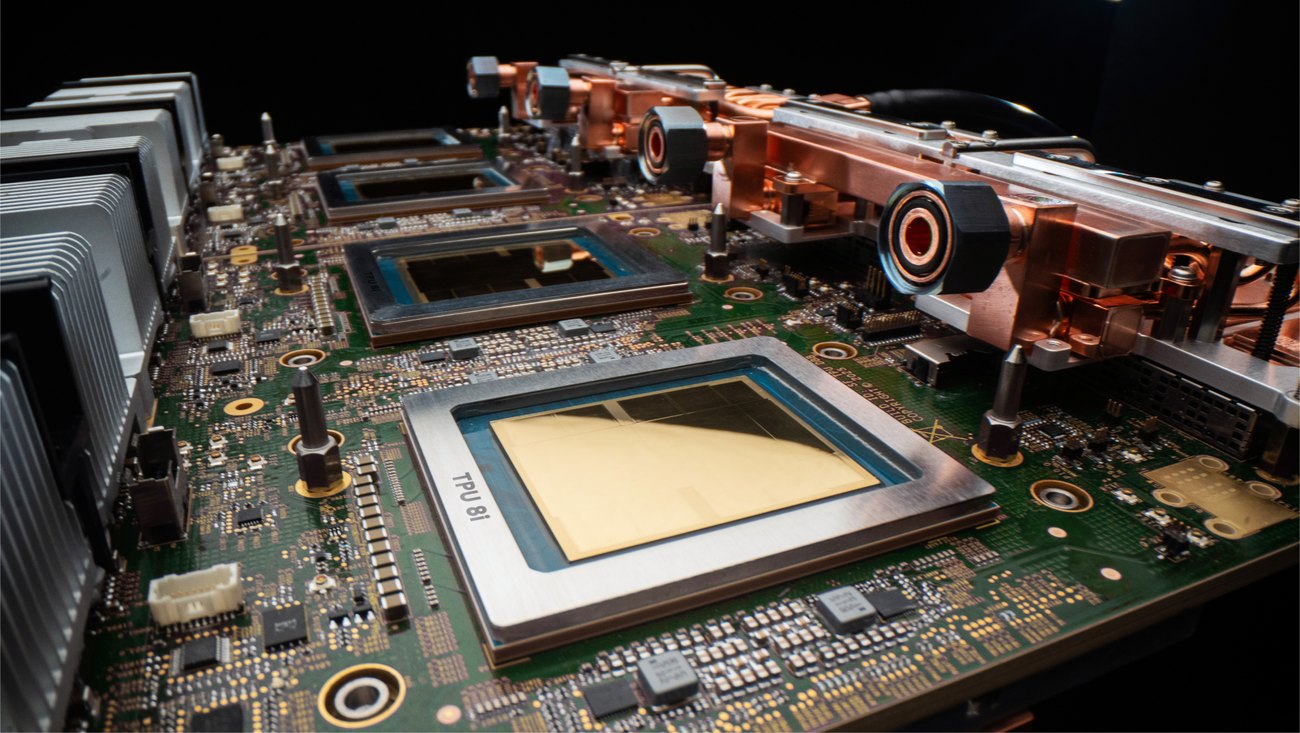
Image: Source: Google · source · editorial use Google previewed its first two-chip TPU generation: 8t for large-scale training and 8i for low-latency agentic inference, with general availability promised for later in 2026 for the first parts. Reports identified Broadcom as the design partner on 8t and MediaTek on 8i, both on TSMC 2nm, and Broadcom later said Anthropic would take 5 GW of 8i in 2027.
- Google (The Keyword) · Apr 22, 2026 ·
Today at Google Cloud Next, we are introducing the eighth generation of Google's custom Tensor Processor Unit (TPU), coming soon with two distinct, purpose-built architectures for training and inference: TPU 8t and TPU 8i. These two chips are designed to power our custom-built supercomputers, to drive everything from cutting-edge model training and agent development, to massive inference workloads.
- Google (The Keyword) · Apr 22, 2026 ·
- AnnouncementKey moment
Amazon puts up to $25 billion more into Anthropic; Anthropic commits $100 billion to AWS and up to 5 GW of Trainium
Amazon invested $5 billion immediately with up to $20 billion more tied to milestones, on top of $8 billion since 2023, and Anthropic committed more than $100 billion over ten years to AWS, securing up to 5 GW across Trainium2, 3 and 4 with nearly 1 GW of Trainium2 and Trainium3 online by end-2026. Anthropic said it already used more than one million Trainium2 chips and kept AWS as its primary training provider.
- Anthropic · Apr 20, 2026 ·
We have signed a new agreement with Amazon that will deepen our existing partnership and secure up to 5 gigawatts (GW) of capacity for training and deploying Claude, including new Trainium2 capacity coming online in the first half of this year and nearly 1GW total of Trainium2 and Trainium3 capacity coming online by the end of 2026.
- Amazon · Apr 20, 2026 ·
Expanding on this success, today Amazon and Anthropic are deepening their collaboration with a commitment from Anthropic to spend more than $100 billion over the next ten years on AWS technologies.
- Anthropic · Apr 20, 2026 ·
- Announcement
Meta commits to a gigawatt of MTIA with Broadcom through 2029; Hock Tan leaves Meta's board
Image: Meta, press image · source · editorial use Meta extended its Broadcom partnership through 2029 with an initial 1 GW deployment of MTIA and multiple gigawatts to follow, on what Broadcom said would be the first 2nm AI silicon. The same day Meta disclosed that Broadcom's CEO would not stand for re-election to its board after two years, moving to an advisory role on the chip program. Tan had told analysts in March that the MTIA roadmap was 'alive and well'.
- CNBC · Apr 14, 2026 ·
Meta and Broadcom on Tuesday announced a sweeping deal that extends an existing partnership between the two companies for the design of Meta's custom in-house AI accelerators through 2029. At the same time, Meta said Broadcom's CEO, Hock Tan, told Meta last week that he has decided not to stand for reelection to Meta's board, according to a filing.
- CNBC · Apr 14, 2026 ·
Meta has committed to an initial deployment of 1 gigawatt of its Training and Inference Accelerators according to a statement. The deal will eventually see Meta deploying multiple gigawatts of chips based on Broadcom technology. The MTIA chips will be the first AI silicon to use a 2 nanometer process, Broadcom said in its own statement.
- Meta Newsroom · Apr 14, 2026 ·
The agreement includes a commitment that exceeds 1GW, which is the first phase of a sustained, multi-gigawatt rollout, reinforcing a shared roadmap to co-design and scale the hardware required to bring personal superintelligence to billions of people globally.
Editor's note: Official source added: https://about.fb.com/news/2026/04/meta-partners-with-broadcom-to-co-develop-custom-ai-silicon/
- CNBC · Apr 14, 2026 ·
- Announcement
Anthropic signs for multiple gigawatts of next-generation TPUs from Google and Broadcom, from 2027
Anthropic called it its most significant compute commitment to date: multiple gigawatts of next-generation TPU capacity from 2027, mostly sited in the United States, on top of the million-TPU deal of October 2025. Broadcom's 8-K put the figure at 3.5 GW and disclosed a long-term supply agreement with Google for future TPU generations through 2031. Anthropic's run-rate revenue had passed $30 billion.
- Anthropic · Apr 6, 2026 ·
We have signed a new agreement with Google and Broadcom for multiple gigawatts of next-generation TPU capacity that we expect to come online starting in 2027.
- TechCrunch · Apr 7, 2026 ·
The company did not give specifics for its compute expansion, but a recent Broadcom SEC filing shows the deal includes 3.5 gigawatts of compute.
- Anthropic · Apr 6, 2026 ·
- AnnouncementKey moment
Meta lays out four MTIA generations in two years: 300, 400, 450 and 500, on a six-month cadence
Meta said it had deployed hundreds of thousands of MTIA chips, renamed the first two parts MTIA 100 and 200, and published a roadmap of four more generations through 2027 that widens the chips from recommendation inference to recommendation training and generative-AI inference, built with Broadcom on modular chiplets. The post committed Meta to iterating silicon at a consumer-hardware pace.
- Meta AI Blog · Mar 11, 2026 ·
Since introducing MTIA 100 and 200, we have accelerated MTIA development across four successive generations: MTIA 300, 400, 450, and 500. These new chips have either already been deployed or are scheduled for deployment in 2026 or 2027, expanding workload coverage from ranking and recommendation (R&R) inference to R&R training, general GenAI workloads, and GenAI inference with targeted optimizations.
- Meta AI Blog · Mar 11, 2026 ·
More importantly, we have deployed hundreds of thousands of MTIA chips in production, onboarded numerous internal production models, and tested MTIA with large language models (LLMs) like Llama.
- Meta AI Blog · Mar 11, 2026 ·
- Report
Meta signs a multibillion-dollar deal to rent Google Cloud TPUs for its next models
Three months after the first report, The Information said Meta had agreed to a multibillion-dollar deal to rent TPUs from Google Cloud to train and run its next-generation models, alongside multibillion-dollar purchases of Nvidia's Vera Rubin and AMD's MI400 GPUs announced the same month. Meta was buying from every accelerator vendor at once while its own MTIA program continued.
- SiliconANGLE · Feb 26, 2026 ·
Meta Platforms Inc. has reportedly agreed to a multibillion-dollar deal to rent Google Cloud’s custom artificial intelligence chips, according to a report in The Information today. The report cited anonymous sources as saying that the chips, known as tensor processing units, will be used by Meta to train and run its next-generation large language models.
contradicts Meta signs for up to 6 gigawatts of AMD GPUs with a custom MI450-based part and a matching warrant on AMD Instinct: From MI300X to Helios and the Gigawatt Deals.
- SiliconANGLE · Feb 26, 2026 ·
- Launch
Maia 200: Microsoft's 3nm inference chip runs GPT-5.2 and Copilot, with outside customers 'in the future'
Microsoft announced its second-generation accelerator, a TSMC 3nm part it called the most efficient inference system it had deployed, claiming 30 percent better performance per dollar than alternatives, and began installing it in its US Central region. It runs OpenAI's GPT-5.2, Microsoft 365 Copilot, Foundry and the superintelligence team's work; unlike Maia 100 it is meant to reach cloud customers eventually.
- CNBC · Jan 26, 2026 ·
The Maia 200 comes two years after Microsoft said it had developed its first AI chip, the Maia 100, which was never made available for cloud clients to rent.
- CNBC · Jan 26, 2026 ·
Microsoft is outfitting its U.S. Central region of data centers with Maia 200 chips, and they'll arrive at the U.S. West 3 region after that, with additional locations to follow. The chips use Taiwan Semiconductor Manufacturing Co.'s 3 nanometer process.
- Microsoft Source · Jan 28, 2026 ·
Deployment has already begun in select U.S. data centers, and the platform will soon power key Microsoft and OpenAI systems — including the latest GPT‑5.2 models from OpenAI, Microsoft Foundry models, and a broad portfolio of Microsoft AI services.
- CNBC · Jan 26, 2026 ·
202513 entries
- Launch
Trainium3 UltraServers go GA: AWS's first 3nm chip, 144 chips and 362 petaflops per system
At re:Invent AWS launched Trn3 UltraServers with up to 4.4x the compute, 4x the energy efficiency and nearly 4x the memory bandwidth of Trainium2 systems, said Bedrock was already serving production traffic on Trainium3, and listed Anthropic among customers cutting costs by up to half on Trainium. Trainium4 was previewed for 2027.
- Amazon · Dec 2, 2025 ·
To help customers overcome these constraints, today we announced the general availability of Amazon EC2 Trn3 UltraServers.
- Amazon · Dec 2, 2025 ·
Trn3 UltraServers pack up to 144 Trainium3 chips into a single integrated system, delivering up to 4.4x more compute performance than Trainium2 UltraServers.
- Amazon · Dec 2, 2025 ·
- Report
Meta in talks to put Google TPUs in its data centers from 2027; Nvidia falls 4 percent
The Information reported that Meta was negotiating to deploy TPUs in its own data centers in 2027 and to rent them from Google Cloud in 2026, and that Google was now promoting TPUs for installation in customers' facilities rather than only in its cloud. Alphabet rose 4 percent and Nvidia fell as much as 7 percent on the report; a Google spokesperson said demand for both TPUs and Nvidia GPUs was accelerating.
- CNBC · Nov 25, 2025 ·
On Monday, The Information reported that Meta is considering using Google's tensor processing units, or TPUs, in its data centers in 2027. Meta may also rent TPUs from Google's cloud unit next year, the publication reported.
- TrendForce · Nov 25, 2025 ·
For years, Google limited its TPUs to its own cloud, offering them solely as rented compute for large-scale AI workloads. ButInvesting.com, citing The Information, notes that Google is now promoting the chips for installation directly inside customers’ data centers—a significant strategic shift that intensifies its competition with NVIDIA. Investing.com also reports that Google Cloud executives view broader TPU adoption as a route to capturing up to 10% of NVIDIA’s annual revenue, representing a multibillion-dollar opportunity.
- CNBC · Nov 25, 2025 ·
- Announcement
Nadella: Microsoft gets all of OpenAI's system-level chip IP through 2030
After the OpenAI recapitalization, Satya Nadella said on Dwarkesh Patel's podcast that Microsoft has rights to the IP for the custom chips OpenAI is developing with Broadcom, gets access to all of OpenAI's system-level innovation, and would first build what OpenAI designs for OpenAI and then extend it into Microsoft's own infrastructure. The arrangement tied the Maia roadmap to OpenAI's chip program.
- Data Center Dynamics · Nov 13, 2025 ·
Microsoft has the rights to the IP for OpenAI's custom AI semiconductors that the startup is developing with Broadcom. In a recent appearance on author Dwarkesh Patel's podcast, and reported by Bloomberg, CEO Satya Nadella said regarding OpenAI's chip development: "As they innovate even at the system level, we get access to all of it.
- Data Center Dynamics · Nov 13, 2025 ·
- Launch
Ironwood reaches general availability, with Claude named alongside Gemini as a TPU-trained model
Google Cloud said Ironwood would be generally available within weeks, with 10x the peak performance of TPU v5p and more than 4x Trillium per chip, and introduced Arm-based Axion N4A instances. The post opened by listing Anthropic's Claude with Gemini, Veo and Imagen as models that train and serve on TPUs.
- Google Cloud Blog · Nov 7, 2025 ·
Ironwood, our seventh generation TPU, will be generally available in the coming weeks.
- Google Cloud Blog · Nov 7, 2025 ·
Today’s frontier models, including Google’s Gemini, Veo, Imagen, and Anthropic’s Claude train and serve on Tensor Processing Units (TPUs).
- Google Cloud Blog · Nov 7, 2025 ·
- LaunchKey moment
Project Rainier is live: nearly 500,000 Trainium2 chips, Claude on more than a million by year-end
AWS said Rainier was fully operational less than a year after it was announced, spread across multiple U.S. data centers, with Anthropic already training and serving Claude on it and expected to be on more than one million Trainium2 chips by the end of 2025. It was the largest deployment of a non-Nvidia accelerator for a frontier model.
- Amazon · Oct 29, 2025 ·
Project Rainier, one of the world's largest AI compute clusters, is now fully operational, less than one year after it was first announced.
- Amazon · Oct 29, 2025 ·
Claude is expected to be on more than 1 million Trainium2 chips—for workloads including training and inference—by the end of the year.
- Amazon · Oct 29, 2025 ·
- AnnouncementKey moment
Anthropic commits to up to one million Google TPUs, more than a gigawatt in 2026
Anthropic announced a deal worth tens of billions of dollars to expand its use of Google Cloud TPUs to as many as one million chips, bringing well over a gigawatt online in 2026, while keeping Amazon as its primary training partner. It was the first time a frontier lab had committed to TPUs at Nvidia-order scale, and it made Anthropic the anchor customer for Ironwood.
- Anthropic · Oct 23, 2025 ·
Today, we are announcing that we plan to expand our use of Google Cloud technologies, including up to one million TPUs, dramatically increasing our compute resources as we continue to push the boundaries of AI research and product development. The expansion is worth tens of billions of dollars and is expected to bring well over a gigawatt of capacity online in 2026.
- CNBC · Oct 23, 2025 ·
The deal, which is worth tens of billions of dollars, is the company's largest TPU commitment yet and is expected to bring well over a gigawatt of AI compute capacity online in 2026.
- Anthropic · Oct 23, 2025 ·
- AnnouncementKey moment
OpenAI and Broadcom: 10 gigawatts of OpenAI-designed accelerators from late 2026 to 2029

Image: OpenAI, press image · source · editorial use OpenAI said it would design its own accelerators and systems, with Broadcom developing and deploying racks connected over Ethernet, starting in the second half of 2026 and completing by end-2029. The 10 GW figure put OpenAI's custom chip program on the same scale as its Nvidia and AMD agreements announced in the preceding weeks.
- OpenAI · Oct 13, 2025 ·
San Francisco and Palo Alto—October 13, 2025—OpenAI and Broadcom today announced a collaboration for 10 gigawatts of custom AI accelerators. OpenAI will design the accelerators and systems, which will be developed and deployed in partnership with Broadcom.
- Reuters via TradingView · Oct 13, 2025 ·
The companies said on Monday that OpenAI would design the chips, which Broadcom will develop and deploy starting in the second half of 2026.
- OpenAI · Oct 13, 2025 ·
- Financial
Broadcom books $10 billion of orders from a fourth custom-chip customer
On its fiscal third-quarter call Broadcom said a fourth XPU customer had released production orders worth $10 billion, with shipments starting in fiscal 2026, and raised its AI outlook; the stock rose 9 percent the next day. Analysts assumed OpenAI, but Broadcom's chip president later said it was not, leaving Anthropic's Ironwood racks as the likely order. Broadcom's known XPU customers at the time were Google, Meta and ByteDance.
- CNBC · Sep 5, 2025 ·
Following a better-than-expected earnings report late Thursday, Broadcom CEO Hock Tan told analysts that a fourth large customer had put in orders for $10 billion in custom artificial intelligence chips, which the company calls XPUs. "One of these prospects released production orders to Broadcom, and we have accordingly characterized them as a qualified customer for XPUs," Tan said.
- CNBC · Oct 13, 2025 ·
Charlie Kawwas, president of the semiconductor solutions group at Broadcom, on Monday said that OpenAI is not the mystery $10 billion customer that it announced during its earnings call in September.
- CNBC · Sep 5, 2025 ·
- Delay
Microsoft delays its next Maia chip, Braga, to 2026 after design setbacks
Data Center Dynamics, citing The Information, reported that mass production of Microsoft's next-generation Maia chip, code-named Braga and expected to ship as Maia 200, had been pushed to 2026. The delay left Microsoft behind Google and Amazon on custom silicon and was still visible in Maia 200's limited footprint a year later.
- Data Center Dynamics · Jun 30, 2025 ·
Microsoft has delayed the mass production of its next-generation Maia AI chips until 2026.
Editor's note: The page states that Microsoft delayed mass production of its next-generation Maia AI chips until 2026 and identifies Braga as the chip expected to be renamed Maia 200. It is dated June 30, 2025, matching the node date.
- Data Center Dynamics · Jun 30, 2025 ·
- LaunchKey moment
Ironwood: the seventh TPU, built for inference, scales to 9,216 chips and 42.5 exaflops
At Cloud Next Google introduced Ironwood as the first TPU designed specifically for inference and 'thinking' models, with 192 GB of HBM per chip and pods of 9,216 chips delivering 42.5 exaflops. It became the chip behind Google's TPU sales push to Anthropic and Meta over the following year.
- Google (The Keyword) · Apr 9, 2025 ·
Today at Google Cloud Next 25, we’re introducing Ironwood, our seventh-generation Tensor Processing Unit (TPU) — our most performant and scalable custom AI accelerator to date, and the first designed specifically for inference.
- Google (The Keyword) · Apr 9, 2025 ·
- Report
Reuters: Google is preparing a second TPU design partner, MediaTek, for a chip to be built in 2026
Reuters, citing The Information, reported that Google was preparing to work with MediaTek on a next-generation TPU expected to be manufactured in 2026, alongside its long-standing Broadcom partnership. Google, MediaTek and Broadcom did not comment. The two-partner split later surfaced as TPU 8t from Broadcom and TPU 8i from MediaTek.
- Reuters via MarketScreener · Mar 17, 2025 ·
Google, MediaTek and Broadcom did not immediately respond to Reuters' requests for comment.
Editor's note: The page is a Reuters article published on 2025-03-17. It reports that Google was preparing to partner with MediaTek on a next-generation TPU to be made the following year, and includes the quoted statement about requests for comment.
- Reuters via MarketScreener · Mar 17, 2025 ·
- Report
Reuters: Meta is testing its first in-house training chip, a step beyond MTIA's inference role
Reuters, via TechCrunch, reported that Meta was testing an in-house chip for training AI systems as part of its strategy to reduce reliance on Nvidia and other hardware makers. It was the first sign that MTIA would move from recommendation inference into training, which Meta confirmed a year later with the MTIA 300 to 500 roadmap.
- TechCrunch · Mar 11, 2025 ·
Meta is reportedly testing an in-house chip for training AI systems, a part of a strategy to reduce its reliance on hardware makers like Nvidia.
Editor's note: The TechCrunch page states that Meta was reportedly testing an in-house chip for training AI systems as part of a strategy to reduce reliance on hardware makers such as Nvidia. It is posted March 11, 2025.
- TechCrunch · Mar 11, 2025 ·
- Financial
Marvell, the other custom-silicon house, says its hyperscaler AI chips are in volume production
On its fiscal fourth-quarter call Marvell said its custom AI silicon programs had entered volume production, the first confirmation that the accelerators it builds for Amazon and Microsoft, widely reported as Trainium and Maia, were shipping at scale, with its interconnect products growing alongside. Broadcom and Marvell between them design most of the hyperscalers' custom chips.
- Marvell · Mar 5, 2025 ·
Our custom AI silicon programs have now entered volume production, and we continue to see strong growth from our interconnect products.
Editor's note: The page states that Marvell's custom AI silicon programs had entered volume production and that its interconnect products continued to show strong growth. It is dated March 5, 2025.
- Marvell · Mar 5, 2025 ·
- Dec 2, 2025Trainium3 UltraServers go GA: AWS's first 3nm chip, 144 chips and 362 petaflops per system
- Nov 25, 2025Meta in talks to put Google TPUs in its data centers from 2027; Nvidia falls 4 percent
- Nov 12, 2025Nadella: Microsoft gets all of OpenAI's system-level chip IP through 2030
- Nov 6, 2025Ironwood reaches general availability, with Claude named alongside Gemini as a TPU-trained model
- Oct 29, 2025Project Rainier is live: nearly 500,000 Trainium2 chips, Claude on more than a million by year-end
- Oct 23, 2025Anthropic commits to up to one million Google TPUs, more than a gigawatt in 2026
- Oct 13, 2025OpenAI and Broadcom: 10 gigawatts of OpenAI-designed accelerators from late 2026 to 2029
- Sep 4, 2025Broadcom books $10 billion of orders from a fourth custom-chip customer
- Jun 30, 2025Microsoft delays its next Maia chip, Braga, to 2026 after design setbacks
- Apr 9, 2025Ironwood: the seventh TPU, built for inference, scales to 9,216 chips and 42.5 exaflops
- Mar 17, 2025Reuters: Google is preparing a second TPU design partner, MediaTek, for a chip to be built in 2026
- Mar 11, 2025Reuters: Meta is testing its first in-house training chip, a step beyond MTIA's inference role
- Mar 5, 2025Marvell, the other custom-silicon house, says its hyperscaler AI chips are in volume production
20243 entries
- Launch
Trainium2 goes GA; AWS and Anthropic announce Project Rainier and preview Trainium3
AWS made Trn2 instances generally available, claiming 30 to 40 percent better price-performance than GPU instances, introduced 64-chip Trn2 UltraServers, and said it was building Project Rainier with Anthropic, an UltraCluster of hundreds of thousands of Trainium2 chips with more than five times the compute used to train Anthropic's current models. Trainium3, on a 3nm process, was previewed for late 2025.
- Amazon press release · Dec 3, 2024 ·
Together with Anthropic, AWS is building an EC2 UltraCluster of Trn2 UltraServers—named Project Rainier—containing hundreds of thousands of Trainium2 chips and more than 5x the number of exaflops used to train their current generation of leading AI models.
- Amazon press release · Dec 3, 2024 ·
Trn2 instances offer 30-40% better price performance than the current generation of GPU-based EC2 P5e and P5en instances and feature 16 Trainium2 chips to provide 20.8 peak petaflops of compute—ideal for training and deploying LLMs with billions of parameters.
- Amazon press release · Dec 3, 2024 ·
- Launch
Trillium, the sixth-generation TPU: 4.7x the compute of v5e at Google I/O
Google announced Trillium with a 4.7x jump in peak compute per chip over TPU v5e, doubled HBM and interconnect bandwidth and 67 percent better energy efficiency, and said the models unveiled at I/O, including Gemini 1.5 Flash, were trained and served on TPUs. Trillium was the last single-purpose TPU before the split into inference and training parts.
- Google Cloud Blog · May 15, 2024 ·
Trillium TPUs achieve an impressive 4.7X increase in peak compute performance per chip compared to TPU v5e.
- Google Cloud Blog · May 15, 2024 ·
- Launch
Meta's second-generation MTIA doubles compute for ranking and recommendation models
Meta detailed its next MTIA inference chip, a year after revealing the first, with more than twice the compute and memory bandwidth of v1 and an SRAM-heavy design tuned for the ads ranking and recommendation models that run its feeds. Meta framed MTIA as a long-term program to own the most efficient silicon for its own workloads rather than a general challenger to GPUs.
- Meta AI Blog · Apr 10, 2024 ·
This new version of MTIA more than doubles the compute and memory bandwidth of our previous solution while maintaining our close tie-in to our workloads.
- Meta AI Blog · Apr 10, 2024 ·
- Dec 3, 2024Trainium2 goes GA; AWS and Anthropic announce Project Rainier and preview Trainium3
- May 14, 2024Trillium, the sixth-generation TPU: 4.7x the compute of v5e at Google I/O
- Apr 10, 2024Meta's second-generation MTIA doubles compute for ranking and recommendation models
20233 entries
- LaunchKey moment
Google's TPU v5p arrives with Gemini, which was trained and served on TPUs
The same day it announced Gemini, Google Cloud introduced TPU v5p, its most powerful accelerator to date, with 8,960 chips per pod, more than twice the FLOPS and three times the HBM of TPU v4, and said Gemini had been trained on and was served from TPUs. It set the pattern for the next three years: each Google model generation ships on a new TPU.
- Google Cloud Blog · Dec 7, 2023 ·
Today, to address these challenges, we are excited to announce Cloud TPU v5p, our most powerful, scalable, and flexible AI accelerator thus far.
- Google Cloud Blog · Dec 7, 2023 ·
In fact, Gemini, Google’s most capable and general AI model announced today, was trained on, and is served, using TPUs.
- Google Cloud Blog · Dec 7, 2023 ·
- LaunchKey moment
AWS announces Trainium2: 4x faster training, clusters of 100,000 chips, Anthropic among first users
At re:Invent AWS introduced Trainium2 alongside Graviton4, promising up to four times the training speed of the first Trainium and deployment in EC2 UltraClusters of up to 100,000 chips. Anthropic, in which Amazon had just agreed to invest up to $4 billion, was named among the customers, the start of the Trainium-for-Claude relationship.
- Amazon press release · Nov 28, 2023 ·
Trainium2 is designed to deliver up to 4x faster training than first generation Trainium chips and will be able to be deployed in EC2 UltraClusters of up to 100,000 chips, making it possible to train foundation models (FMs) and large language models (LLMs) in a fraction of the time, while improving energy efficiency up to 2x.
- Amazon press release · Nov 28, 2023 ·
- LaunchKey moment
Microsoft unveils Maia 100, its first AI accelerator, at Ignite
Microsoft showed the Azure Maia 100 AI accelerator and the Arm-based Cobalt 100 CPU, chips it had been testing in secret in a Redmond lab, and said they would start rolling out to its data centers in early 2024 to run Copilot and Azure OpenAI Service. Maia 100 was never offered to cloud customers; its significance was that the last of the big three clouds had joined Google and Amazon in designing its own AI silicon.
- Microsoft Source · Nov 15, 2023 ·
Today at Microsoft Ignite the company unveiled two custom-designed chips and integrated systems that resulted from that journey: the Microsoft Azure Maia AI Accelerator, optimized for artificial intelligence (AI) tasks and generative AI, and the Microsoft Azure Cobalt CPU, an Arm-based processor tailored to run general purpose compute workloads on the Microsoft Cloud.
- Microsoft Source · Nov 15, 2023 ·
The chips will start to roll out early next year to Microsoft’s datacenters, initially powering the company’s services such as Microsoft Copilot or Azure OpenAI Service.
- Microsoft Source · Nov 15, 2023 ·
Questions this timeline answers
Each one is an ordered set of dated entries, most of them from this page, with a line on why each step led to the next.
Cause and effect
- Meta signs for up to 6 gigawatts of AMD GPUs with a custom MI450-based part and a matching warrant on AMD Instinct: From MI300X to Helios and the Gigawatt Dealsis contradicted by →Meta signs a multibillion-dollar deal to rent Google Cloud TPUs for its next modelsThe entries describe Meta's February 2026 AMD agreement with different accelerator generations: Timeline B says its custom part is based on MI450, while Timeline A calls the announced purchase MI400 GPUs.
Where sources disagree or fall silent
- Google’s reported TPU 8i design-partner arrangement is unclear: earlier reporting identified MediaTek as the 8i partner, while Broadcom later said it had begun production shipments of TPU 8i and described major Anthropic 8i capacity.
- It is not yet clear whether OpenAI’s Jalapeño performance claims will be independently reproduced; SemiAnalysis verified a run in OpenAI’s lab but did not run the full benchmark suite or see AgentX results.
- The timing and scale of Microsoft’s Maia 300 deployment remain unconfirmed. Reporting described a possible September reveal and more than 300,000 TSMC units for 2027, while Microsoft has announced only a multi-gigawatt Maia target beginning in 2027.
- Anthropic has confirmed an internal chip team but has not identified a manufacturing partner, architecture, production date or deployment scale. Samsung has only been reported as a possible manufacturer.
- The announced multi-gigawatt deployments depend on manufacturing and systems capacity that is not fully secured in public disclosures. Broadcom has specifically cited substrate constraints and said it is building Singapore capacity with a partner.
- Google’s plans to place TPUs in customer data centers, rather than only rent them through Google Cloud and Crux AI, have been reported but not fully detailed by Google.
What to watch next
- Nov 17, 2026 — Microsoft Ignite 2026 begins Microsoft could clarify Maia 300’s status, its production schedule and whether Maia 200 will become available to external Azure customers.
- Nov 30, 2026 — AWS re:Invent 2026 begins AWS has used re:Invent for Trainium launches and could update Trainium4 timing and Anthropic capacity deployments.
- Apr 13, 2027 — Google Cloud Next 2027 begins Google could provide availability and customer-deployment details for TPU 8t and TPU 8i after their 2026 preview.
Who is involved
- Googlecompany
Develops TPU accelerators and is expanding their use from Google Cloud into large customer and neocloud deployments.
- Broadcomcompany
Primary custom-silicon and systems partner for Google, Meta and OpenAI, and a disclosed supplier for Anthropic’s future TPU capacity.
- Metacompany
Develops MTIA for recommendation and generative-AI workloads while also renting Google TPUs and buying other accelerator capacity.
- OpenAIcompany
Designed the Jalapeño inference accelerator with Broadcom and plans a 10 GW custom-chip deployment through 2029.
- Anthropiccompany
The largest announced customer for both AWS Trainium and Google TPUs, and is also building an internal chip-design team.
- Microsoftcompany
Develops Azure Maia accelerators, runs Maia 200 internally, has rights to OpenAI’s system-level chip IP, and targets multi-gigawatt Maia deployments from 2027.
- Jalapeñoproduct
OpenAI’s first custom inference chip; engineering samples are running in the lab, while Broadcom projects 1.3 GW of deployment in 2027.
- Amazon Web Servicescompany
Develops Trainium and supplies Anthropic’s Project Rainier and longer-term Trainium capacity.
37 more
- MTIAproduct
Meta’s custom accelerator roadmap, with deployed 100 and 200 chips and planned 300, 400, 450 and 500 generations through 2027.
- Hock Tanperson
Broadcom’s chief executive, who has disclosed customer deployment plans and moved from Meta’s board to an advisory role on its chip program.
- Maia 200product
Microsoft's planned next-generation Maia chip identified in the reported production delay.
- Marvell Technology, Inc.company
Entered the Google commercial agreement and disclosed custom-silicon revenue targets and shipments.
- TPU 8iproduct
Google accelerator for which Broadcom reported beginning production shipments.
- TSMCcompany
Manufactures major hyperscaler accelerator designs, including Maia 200, and is central to expected 2 nm TPU and MTIA production.
- Alphabetcompany
Parent company named in reporting on the Crux AI venture and financing.
- Blackstonecompany
Google’s partner in Crux AI, a neocloud venture intended to rent Google TPUs to outside customers.
- Crux AIcompany
Google and Blackstone’s TPU-focused cloud venture, reported to be arranging financing for TPU purchases ahead of planned 2027 rentals.
- MediaTekcompany
Reportedly became Google’s second TPU design partner, though later disclosures make its precise role in TPU 8i unclear.
- Nvidiacompany
The incumbent accelerator supplier that the custom-chip programs aim to supplement or reduce dependence on.
- Project Rainierproduct
AWS's large Trainium cluster for Anthropic, reported live with nearly 500,000 Trainium2 chips in October 2025.
- Satya Nadellaperson
Microsoft chief executive who said Microsoft has access to OpenAI’s custom-chip and system-level IP through 2030.
- TPUproduct
Google’s accelerator family, progressing from v5p and Trillium to Ironwood and the forthcoming TPU 8t and 8i systems.
- Arkeproduct
Code name for MTIA 450.
- Azure Maiaproduct
Microsoft’s in-house accelerator family, spanning Maia 100, Maia 200 and the planned Maia 300.
- Bank of Nova Scotiacompany
Bank named in reporting on the proposed Crux AI financing.
- Barclayscompany
Bank named in reporting on the proposed Crux AI financing.
- BNP Paribascompany
Bank named in reporting on the proposed Crux AI financing.
- Celesticacompany
Handles implementation, boards, racks and networking for OpenAI’s Jalapeño systems.
- Goldman Sachscompany
Bank named in reporting on the proposed Crux AI financing.
- Google LLCcompany
Entered the commercial agreement with Marvell for custom semiconductor products.
- Google TPUproduct
Google's accelerator line spans v5p, Trillium and inference-focused Ironwood, with TPU 8t for training and TPU 8i for inference planned as the next split generation.
- InferenceXproduct
Benchmark workload whose lab runs SemiAnalysis verified in part.
- Marvellcompany
A second major custom-silicon supplier that says its hyperscaler AI-chip programs have entered volume production.
- MTIA 300product
Meta training accelerator for which Tahan was purpose-built.
- MTIA 450product
Meta accelerator planned for data-center introduction in the first half of 2027.
- OpenAI Koreacompany
OpenAI regional organization associated with preceding remarks about Samsung Electronics cooperation.
- Richard Hoperson
OpenAI hardware chief who said Jalapeño capacity will be needed internally for a long time.
- Samsungcompany
Company named in reports about possible OpenAI chip manufacturing plans.
- Sarah Friarperson
OpenAI CFO who said the company needs multiple chip providers to reduce supply-chain risk.
- SemiAnalysiscompany
Reported that OpenAI provided the benchmark figures.
- Song Ijunperson
Meta engineering vice president who said MTIA 450 is planned for data-center introduction in the first half of 2027.
- Sumitomo Mitsui Banking Corporationcompany
Bank named in reporting on the proposed Crux AI financing.
- Tahanproduct
Meta Ethernet-based scale-up switch.
- Trilliumproduct
Google TPU made available in preview.
- XPUproduct
Next-generation accelerator beyond Jalapeño that Broadcom said was nearing tape-out.
Changelog
- Added 3 entries: 2026-10-09 Google claims TPU 8i has 80% better price-performance; 2026-10-12 Microsoft targets multi-gigawatt Azure Maia deployments from 2027; 2026-10-12 Meta introduces Tahan Ethernet scale-up switch for MTIA 300.
- Added 2 entries: 2026-08-25 OpenAI publishes Jalapeño performance claims; 2026-09 Google and Blackstone launch TPU cloud venture Crux AI. Linked 1 entry with AMD Instinct: From MI300X to Helios and the Gigawatt Deals. Added 3 entries: 2026-07-29 Marvell and Google enter custom-semiconductor agreement; 2026-10-06 Marvell raises fiscal-2029 custom-revenue target above $12 billion; 2026-10-06 Marvell says it ships custom silicon to four U.S. hyperscalers.
- Added 7 entries: 2026-08-25 OpenAI discloses a 128-chip Jalapeño deployment configuration; 2026-09-01 Meta receives 12 new chip samples from TSMC; 2026-09-02 Broadcom begins production shipments of Google TPU 8i; 2026-09-02 Broadcom says post-Jalapeño XPU is nearing tape-out and 3 more.
- Added 3 entries: 2026-09-09 OpenAI says it did not announce Samsung chip manufacturing plans; 2026-09-15 Sarah Friar says OpenAI needs multiple chip providers; 2026-09-16 Banks arrange reported $22 billion Crux AI loan for Google TPUs.
- Added 4 entries: 2025-03-05 Marvell, the other custom-silicon house, says its hyperscaler AI chips are in volume production; 2025-03-11 Reuters: Meta is testing its first in-house training chip, a step beyond MTIA's inference role; 2025-03-17 Reuters: Google is preparing a second TPU design partner, MediaTek, for a chip to be built in 2026; 2025-06-30 Microsoft delays its next Maia chip, Braga, to 2026 after design setbacks. Added 27 hand-verified entries by the editor.
A research pass records each dated fact with the page it came from and a verbatim quote. A second, independent pass re-opens every cited page and rejects entries it cannot confirm. The editor reviews what remains before it is published, and every change is listed above. Full method.