How Nvidia Came to Own AI Compute: From CUDA to the H100 Shortage
Nvidia’s AI-computing position began with CUDA in 2006, which made GPUs programmable for general-purpose parallel computing. AlexNet’s 2012 ImageNet result showed that a deep neural network could be trained effectively with GPUs, and Nvidia later built Tensor Cores and data-center products such as the V100 and A100 around AI workloads. ChatGPT’s November 2022 release coincided with a broader rush for generative-AI computing capacity; Nvidia said in May 2023 that it was increasing supply to meet surging demand. By fiscal 2024, Nvidia reported $47.5 billion in data-center revenue, up 217% year over year, but the cited results do not separate H100 sales from other data-center products or quantify the shortage directly.
Key moments
- Nov 8, 2006Nvidia unveils CUDA: the GPU becomes a general-purpose processor with a C compiler
- May 10, 2017Volta V100 adds Tensor Cores: the first data-center GPU designed around AI training
- Nov 30, 2022OpenAI launches ChatGPT as a free research preview
- Feb 21, 2024Fiscal 2024 closes with data-center revenue of $47.5 billion, up 217 percent
Timeline
20241 entry
- FinancialKey moment
Fiscal 2024 closes with data-center revenue of $47.5 billion, up 217 percent
Nvidia reported fourth-quarter data-center revenue of $18.4 billion, up 409 percent from a year earlier, and full-year data-center revenue of $47.5 billion, up 217 percent. In one fiscal year the data-center business went from a large segment to most of the company, on the back of a single product generation.
- NVIDIA Newsroom · Feb 21, 2024 ·
Fourth-quarter revenue was a record $18.4 billion, up 27% from the previous quarter and up 409% from a year ago. Full-year revenue rose 217% to a record $47.5 billion.
- NVIDIA Newsroom · Feb 21, 2024 ·
20232 entries
- Financial
Data-center revenue of $10.32 billion, up 171 percent in a year
Second-quarter fiscal 2024 data-center revenue more than doubled from the prior quarter to a record $10.32 billion, up 141 percent sequentially and 171 percent from a year earlier, as H100 systems shipped to cloud providers and consumer-internet companies. It was the quarter the demand shift first showed in Nvidia's numbers.
- NVIDIA Newsroom · Aug 23, 2023 ·
Second-quarter revenue was a record $10.32 billion, up 141% from the previous quarter and up 171% from a year ago.
result of NVIDIA begins shipping Hopper-based H100 GPUs on Nvidia Data Center GPUs: Hopper, Blackwell and Vera Rubin.
- NVIDIA Newsroom · Aug 23, 2023 ·
- Financial
Nvidia reports "surging demand" and says it is significantly increasing supply
With first-quarter fiscal 2024 data-center revenue at a record $4.28 billion, Jensen Huang said the computer industry was going through two transitions at once, accelerated computing and generative AI, and that Nvidia was significantly increasing supply to meet surging demand. The guidance that followed became the clearest public marker of the H100 shortage.
- NVIDIA Newsroom · May 24, 2023 ·
“The computer industry is going through two simultaneous transitions — accelerated computing and generative AI,” said Jensen Huang, founder and CEO of NVIDIA.
- NVIDIA Newsroom · May 24, 2023 ·
20221 entry
- LaunchKey moment
OpenAI launches ChatGPT as a free research preview

Image: OpenAI, press image · source · editorial use OpenAI released ChatGPT, a conversational model trained with reinforcement learning from human feedback, free to use during its research preview. Its adoption over the following weeks turned generative AI from a research budget into a capital-expenditure race among cloud providers, all of whom were buying the same GPU.
- OpenAI · Nov 30, 2022 ·
We’ve trained a model called ChatGPT which interacts in a conversational way.
- OpenAI · Nov 30, 2022 ·
20201 entry
- Launch
A100 in full production: Ampere unifies training and inference, adopted by every major cloud
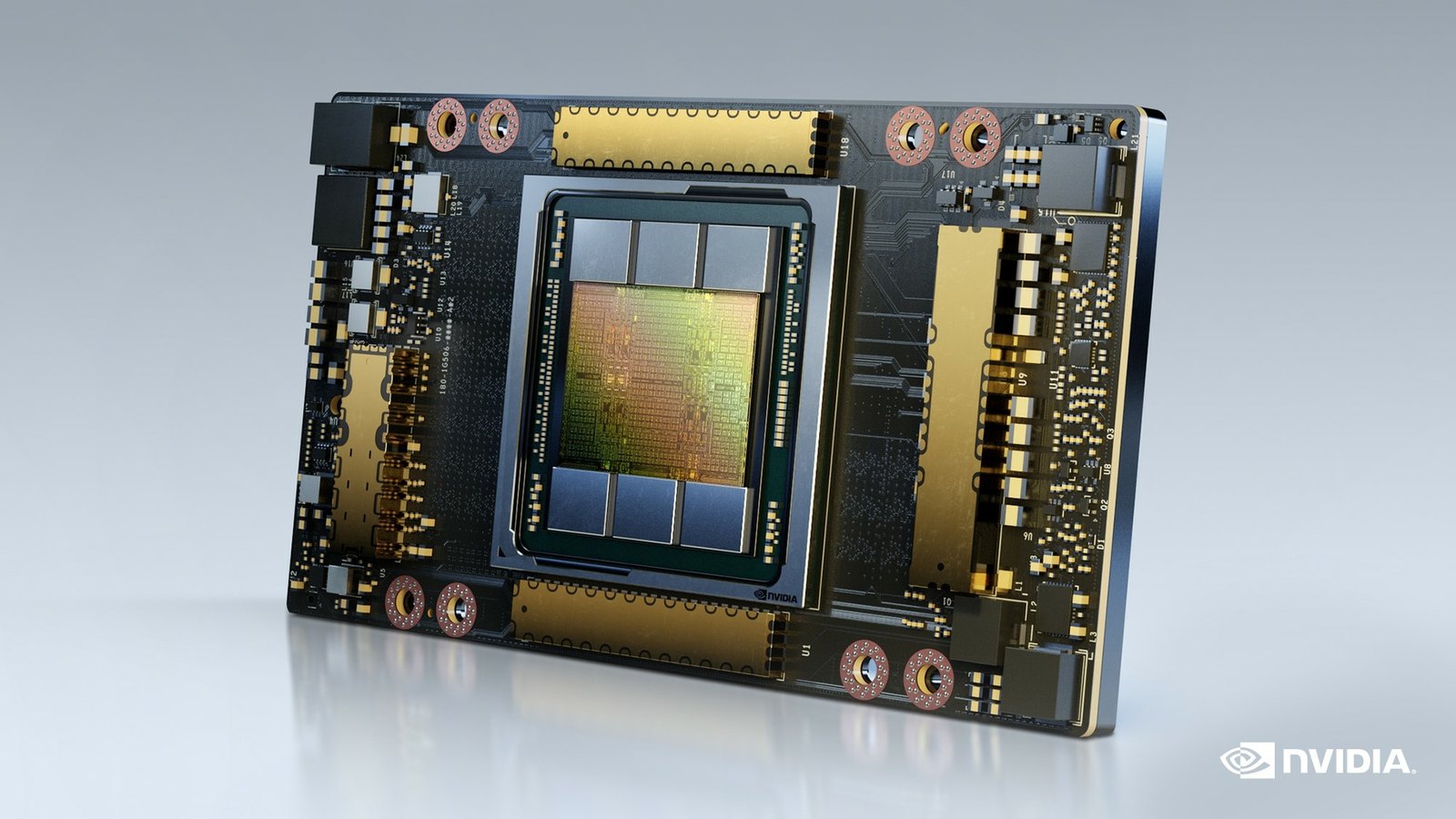
Image: NVIDIA, press image · source · editorial use Nvidia said the first Ampere GPU, the A100, was in full production and shipping worldwide, with up to 20 times the performance of its predecessors and adoption by the top cloud providers and server makers. The A100 was the chip the large language models of 2020 to 2022 were trained on, which is why the H100 launched into an installed base that already ran on Nvidia.
- NVIDIA Newsroom · May 14, 2020 ·
NVIDIA today announced that the first GPU based on the NVIDIA® Ampere architecture, the NVIDIA A100, is in full production and shipping to customers worldwide.
led to Nvidia announces the Hopper architecture and H100 GPU at GTC 2022 on Nvidia Data Center GPUs: Hopper, Blackwell and Vera Rubin.
- NVIDIA Newsroom · May 14, 2020 ·
20171 entry
- LaunchKey moment
Volta V100 adds Tensor Cores: the first data-center GPU designed around AI training
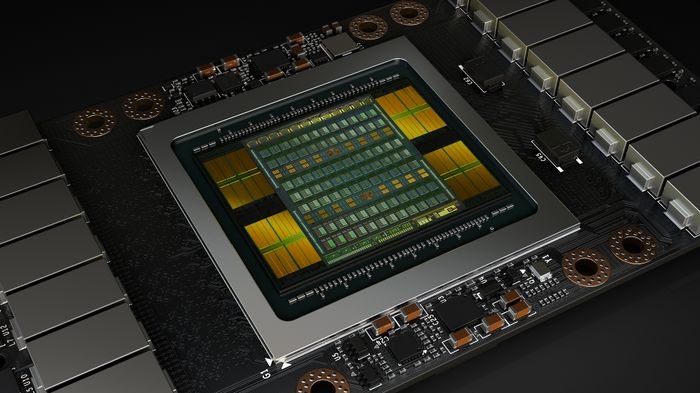
Image: NVIDIA, press image · source · editorial use At GTC 2017 Nvidia launched the Volta platform and the Tesla V100, with 640 Tensor Cores delivering 120 teraflops of deep-learning performance, which it equated to 100 CPUs. Tensor Cores made matrix math a first-class hardware feature, the design choice every later generation has extended.
- NVIDIA Newsroom · May 10, 2017 ·
Equipped with 640 Tensor Cores, V100 delivers 120 teraflops of deep learning performance, equivalent to the performance of 100 CPUs.
- NVIDIA Newsroom · May 10, 2017 ·
20121 entry
- Report
AlexNet: a deep network trained on two GPUs wins ImageNet by a wide margin
Krizhevsky, Sutskever and Hinton reported a 60-million-parameter convolutional network that cut ImageNet's top-5 error to 18.9 percent, far below the previous state of the art, and credited "a very efficient GPU implementation" for making the training feasible. The result is the moment deep learning and Nvidia GPUs became tied together in research practice.
- NeurIPS 2012 proceedings · Dec 3, 2012 ·
On the test data, we achieved top-1 and top-5 error rates of 39.7% and 18.9% which is considerably better than the previous state-of-the-art results. The neural network, which has 60 million parameters and 500,000 neurons, consists of five convolutional layers, some of which are followed by max-pooling layers, and two globally connected layers with a final 1000-way softmax. To make training faster, we used non-saturating neurons and a very efficient GPU implementation of convolutional nets.
- NeurIPS 2012 proceedings · Dec 3, 2012 ·
20061 entry
- LaunchKey moment
Nvidia unveils CUDA: the GPU becomes a general-purpose processor with a C compiler
Nvidia introduced CUDA as a new architecture for computing on its graphics processors and the first C-compiler development environment for the GPU, pitching hundreds of on-chip cores working in parallel at up to 100 times the speed of conventional approaches. It is the software layer that later let researchers train neural networks on gaming cards, and the ecosystem rivals still have to work around.
- NVIDIA press release (Wayback Machine) · Nov 8, 2006 ·
NVIDIA Corporation (Nasdaq: NVDA), the worldwide leader in graphics processors, today unveiled NVIDIA CUDA technology, a fundamentally new architecture for computing on NVIDIA graphics processing units (GPUs), and the industry's first C-compiler development environment for the GPU.
- NVIDIA press release (Wayback Machine) · Nov 8, 2006 ·
Questions this timeline answers
Each one is an ordered set of dated entries, most of them from this page, with a line on why each step led to the next.
Cause and effect
- A100 in full production: Ampere unifies training and inference, adopted by every major cloudled to →Nvidia announces the Hopper architecture and H100 GPU at GTC 2022 on Nvidia Data Center GPUs: Hopper, Blackwell and Vera RubinThe A100's widespread cloud and server-maker adoption created the installed base into which Timeline B says the H100 launched.
- NVIDIA begins shipping Hopper-based H100 GPUs on Nvidia Data Center GPUs: Hopper, Blackwell and Vera Rubinled to →Data-center revenue of $10.32 billion, up 171 percent in a yearNVIDIA's start of Hopper-based H100 shipments preceded Nvidia's reported data-center revenue surge, which the later entry says came as H100 systems shipped to cloud providers and consumer-internet companies.
Where sources disagree or fall silent
- Nvidia’s fiscal-2024 disclosures do not break out H100 revenue or unit shipments from revenue generated by other data-center products.
- The cited sources show Nvidia increasing supply amid surging demand, but do not quantify the size, duration, or customer allocation of the reported H100 shortage.
- The sources document Nvidia’s growth and product milestones but do not provide a direct comparison of its AI-compute market share with competitors.
Who is involved
- Nvidiacompany
Built the CUDA software platform and successive data-center GPU generations that supplied the AI-computing demand described in the timeline.
- Jensen Huangperson
Nvidia’s CEO, who said in May 2023 that the company was significantly increasing supply to meet surging demand.
- OpenAIcompany
Released ChatGPT as a research preview in November 2022.
Changelog
- Linked 1 entry with Nvidia Data Center GPUs: Hopper, Blackwell and Vera Rubin.
- Linked 1 entry with Nvidia Data Center GPUs: Hopper, Blackwell and Vera Rubin.
- Added 8 hand-verified entries by the editor.
A research pass records each dated fact with the page it came from and a verbatim quote. A second, independent pass re-opens every cited page and rejects entries it cannot confirm. The editor reviews what remains before it is published, and every change is listed above. Full method.